
.png)
Today’s News | 26 December 2025
Today’s article makes an uncomfortable but necessary point, especially for museums, heritage institutions, and large public spaces.
Top museums already have cameras. Yet incidents still happen. This alone proves something important. Security failure is not about how many cameras you install. It is about the intelligence behind them.
Most surveillance systems today, including many so-called command centres, are still passive. They operate like post-mortem tools. An offence happens first. Only after that do teams rewind footage to understand who entered, what was taken, and how it happened.
That is documentation. Not prevention.
This is where the AI-led Pro Digital Surveillance Command Centre is fundamentally different. It is not designed to watch history. It is designed to act while the incident is unfolding.
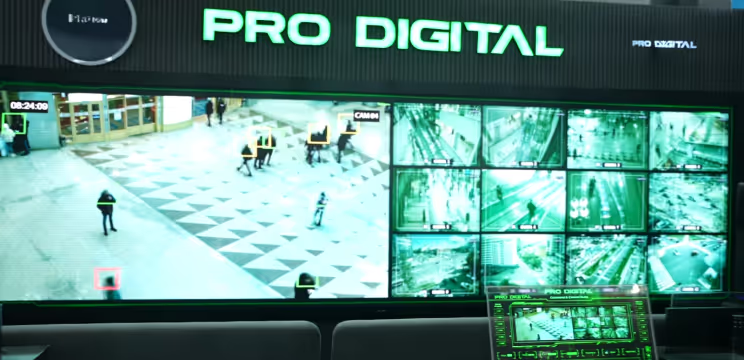
From passive surveillance to situational intelligence
Intelligence-led command centres are not about staring at screens. They are about systems that detect, correlate, and alert in real time.
Here is how such command centres are actually supposed to work:
If someone crosses a defined perimeter, an alert reaches the command centre instantly
If an imaginary line drawn on a CCTV feed is breached during odd hours, a real-time alert is triggered
If there is a fire or smoke signature, the command centre is notified immediately
In factories, if a person enters a zone without a helmet or safety uniform, the system flags it
In hospitals, if a person falls, a fall-detection alert is generated in real time
Crowd behaviour, loitering, and abnormal movement patterns are identified before escalation
This is not surveillance. This is situational intelligence.
The article published today reinforces this reality. Even world-class museums with extensive camera networks failed to stop incidents because the cameras were only recording, not thinking.
Cameras are not the problem. Intelligence is the gap.
One of the most important points that must be clearly stated is this.
Pro Digital AI Edge does not require you to replace your existing CCTV cameras.
In most projects, people are advised to rip and replace systems with high-end cameras. That approach is expensive, disruptive, and often unnecessary.
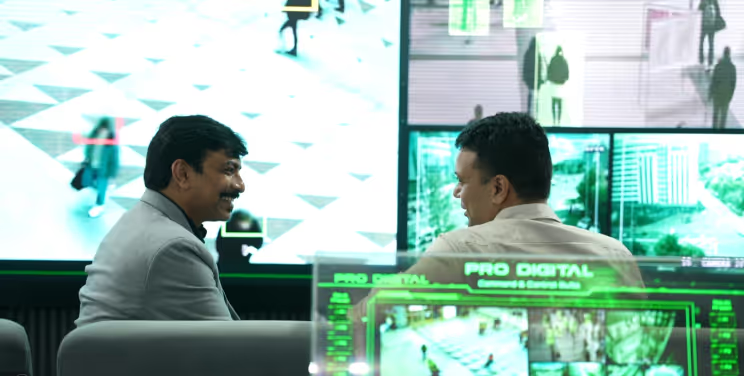
Our approach is different:
Intelligence is deployed on-premise, at the edge
The system works without connecting to the internet
Existing CCTV infrastructure is fully retained
Intelligence is layered on top of current camera feeds
Real-time alerts are generated without changing the physical camera network
Organisational security, data sovereignty, and operational confidentiality remain fully intact
This is not surveillance. This is situational intelligence.
The real takeaway from today’s news
Security failures rarely happen because organisations did not invest in cameras. They happen because systems were designed to observe, not to intervene.
The future of security lies in intelligence-led command centres that respond during the incident, not after it.
From cameras to command centres. From monitoring to intelligence.
%402x%20(1).svg)