
.png)
Drone tenders for Power Lines are being written like wedding photography contracts
Across multiple states, government tenders for drone-based inspection of power transmission and distribution lines are being released with good intent. But when you read many of these scopes carefully, the thinking stops at flying drones and collecting visuals.
The tender language often reads closer to wedding drone photography contracts than to critical power infrastructure intelligence programs.
The Real Problem Starts After the Drone Lands
Modern drone inspections generate enormous volumes of data. LiDAR point clouds run into terabytes. High-resolution photogrammetry creates thousands of images. Thermal datasets multiply with seasonal and repeat inspections.
Most tenders never answer the most basic operational question: what does the department actually do with this data every day? In reality, utilities are left with hundreds of hard disks, vendor-specific formats no one internally can use, no mapped servers or structured storage, and no dedicated teams to monitor, analyse, or act on the information. Data without an operating environment is not intelligence. It is digital baggage.
Power Grid Data Needs a Physical Command Centre
Power utilities are custodians of mission-critical infrastructure. Their data cannot live on pen drives, portable disks, or ad-hoc laptops. Drone inspection data demands a centralised, physical Power Grid Command Centre, supported by:
Dedicated servers and scalable storage
High-performance compute for LiDAR processing and AI analytics
Secure networks for ingestion and access
Redundancy, backup, and continuity planning
Without this backbone, even the best drone program collapses after the first cycle.
Manual defect identification will never scale.
Expecting teams to manually review thousands of images and point clouds is unrealistic at grid scale. This is where most drone programs quietly fail. AI must replace manual screening to detect thermal hotspots, sag beyond thresholds, clearance violations, vegetation encroachment, and structural deviations. Humans should validate and decide, not search and measure.
Closing the loop is the only way this works.
Drone inspections deliver value only when the loop is closed. Defects identified through photogrammetry, thermal, and LiDAR data must flow into a centralised command centre with mapped servers and storage. AI flags risks and trends, tasks are assigned to field teams with exact geo-coordinates, rectification happens through mobile apps, and updates return to the command centre. Asset health must update in near real time. Without this loop, drones simply collect content.
Pro Digital - AI Based Platform for Asset Inspection
Who is actually watching the data?
This is the uncomfortable truth. Even when drone data is collected and stored, most utilities do not have daily monitoring workflows, clear ownership, or trained teams focused on aerial intelligence. Drone inspections are treated as one-time surveys, not continuous operational inputs. A power grid command centre must work as a live intelligence hub where aerial data is ingested continuously, AI analyses sag, clearance, distance, and thermal anomalies, risks are tracked daily, and decisions are made before failures occur. If no one is looking at the data every day, inspections lose all preventive value.
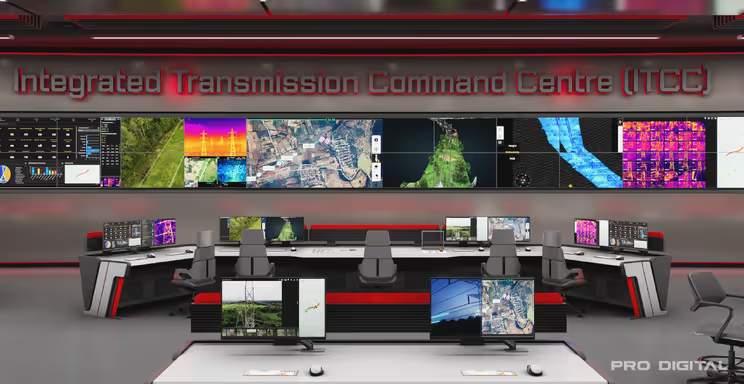
Pro Digital's Integrated Transmission Command Centre - ITCC
Add-on: the missing layer is a digital twin of power lines. Even with drones, AI, and a command centre, most tenders miss one critical element: a digital twin. This is not a 3D visual for presentations. It is a continuously updated operational model of towers, conductors, terrain, vegetation, clearances, sag profiles, and asset health. It becomes the single source of truth inside the power grid command centre.
Why the digital twin matters. Without a digital twin, every inspection starts from scratch, trend analysis is manual, and knowledge disappears with vendors. With a digital twin, every drone flight updates the same model. LiDAR refines geometry and sag baselines, photogrammetry updates visual condition, thermal data adds live stress indicators, and AI analyses behaviour over time. This is what enables predictive maintenance, not reactive repairs.
Drones do not protect power grids. Photos do not prevent failures. Hard disks do not create resilience. Only command centre-driven, digital twin-based intelligence systems do. Until tenders reflect this reality, utilities will keep receiving visuals, not operational intelligence.
%402x%20(1).svg)